
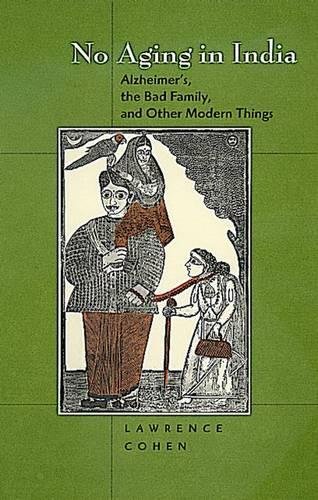
No aging in India : Alzheimer's, the bad family, and other modern things / Lawrence Cohen.
Material type: TextPublication details: Berkeley : University of California Press, c1998.Description: xxv, 367 p. : ill. ; 24 cmISBN:
 - 0520083962 (alk. paper)
- 9780520083967 (alk. paper)
- 9780520224629
- 0520224620
- Aging -- Anthropological aspects
- Ethnology -- India -- Vārānasi (Uttar Pradesh)
- Aging -- Anthropological aspects -- India -- Vārānasi (Uttar Pradesh)
- Senile dementia -- India -- Vārānasi (Uttar Pradesh)
- Alzheimer's disease -- India -- Vārānasi (Uttar Pradesh)
- Aging
- Anthropology, Cultural
- Alzheimer Disease
- Dementia
- Vārānasi (Uttar Pradesh, India) -- Social life and customs
- India
- 305.26
- GN485 .C64 1998
- A digital reproduction is available from E-Editions, a collaboration of the University of California Press and the California Digital Library's eScholarship program.
| Cover image | Item type | Current library | Home library | Collection | Shelving location | Call number | Materials specified | Vol info | URL | Copy number | Status | Notes | Date due | Barcode | Item holds | Item hold queue priority | Course reserves | |
|---|---|---|---|---|---|---|---|---|---|---|---|---|---|---|---|---|---|---|
 Main
Main
|
RTC Library Main opac | Main TEST | 305.26 COH | 177737 | Available | 30019018 |
Includes bibliographical references (p. 329-351) and index.
1. Orientations -- 2. Alzheimer's Hell -- 3. Knowledge, Practice, and the Bad Family -- 4. Memory Banks -- 5. The Anger of the Rishis -- 6. The Maladjustment of the Bourgeoisie -- 7. Chapati Bodies -- 8. Dog Ladies and the Beriya Baba -- 9. The Body in Time.
Cohen draws extensively on years of fieldwork, especially with families and institutions in the Indian city of Varanasi (Banaras). He links the everyday politics of when and how old persons are listened to by their children and others with events and processes around India and around the world - the generational dynamics of Indian cinema, advertising, and popular medicine; the formation of international gerontology and its relation to Indian state welfare and social science; and the intensified marketing of senility drugs globally. Cohen's analysis leads us to consider the centrality of the old body in the emergence of colonized elites and in the cultural politics of colonial and postcolonial identity across class. No Aging in India takes us from the study of aging to the idea of age itself.
A digital reproduction is available from E-Editions, a collaboration of the University of California Press and the California Digital Library's eScholarship program.